
Why Russian Propaganda Works – And How to Stop Falling For It

One of the biggest mistakes people make about propaganda is assuming it only works on uneducated or unintelligent people.
That is simply false.
Some of the smartest people I know repeat Kremlin narratives almost word for word. Not because they are evil. Not because they are Russian agents. And often not even because they consciously support Putin.
They fall for it because modern propaganda is not designed to convince you that something is true. It is designed to make you doubt that truth exists at all.
The Goal Is Not Persuasion. The Goal Is Confusion.
Russian propaganda does not try to convince you of one clear story. Instead, it floods the information space with contradictory narratives:
“Ukraine is to blame.” “NATO provoked the war.” “Nothing can be verified.” “Both sides are equally guilty.”
The goal is not to make you believe something specific. The goal is to make you uncertain about everything. Because when people are confused, they disengage. And when they disengage, truth loses.
We saw this during COVID. Misinformation spread faster than facts, emotional content overrode analysis, and repetition created a false sense of familiarity. Propaganda works the same way – except it is not chaotic. It is intentional, strategic, and persistent.
The result is moral paralysis. People stop asking “What is true?” and start asking “Who knows what is true anymore?” That sentence alone is one of the Kremlin’s greatest victories.
Social Media Built the Perfect Weapon
Social media did not create propaganda. But it industrialized it.
Algorithms reward emotion, outrage, and tribalism. The most viral content is rarely the most accurate – it is the most emotionally stimulating. Nuance loses. Anger wins. Careful analysis loses. Conspiracy theories win.
Once enough real people begin repeating propaganda voluntarily, the system becomes self-sustaining. At that point, propaganda no longer looks like propaganda. It looks like public opinion.
Why Smart People Fall For It
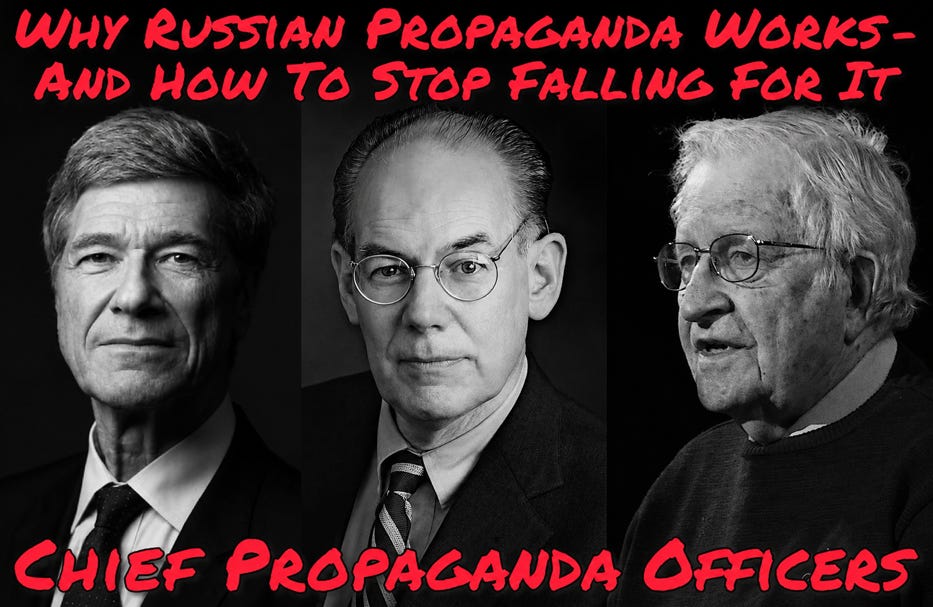
Recently I had a conversation with someone from academic circles who argued that people like Jeffrey Sachs, John Mearsheimer, and Noam Chomsky cannot possibly be spreading Russian propaganda because they are smart and well-educated.
This argument misses three things.
First, being smart in one field does not make you an expert in another. Every time I listen to Jeffrey Sachs speak about Ukraine, I am struck by his ignorance on the subject. He may be a decent economist, but he clearly knows nothing about Ukrainian-Russian history.
Second, much smarter people have dismantled their arguments repeatedly. Hundreds of scholars have signed open letters pointing out exactly where these “experts” get the history wrong.
Third, and most importantly – the merit of an argument has nothing to do with the credentials of the person making it. Any serious historian will tell you that blaming NATO for Russia’s invasion of Ukraine reflects either ignorance or deliberate dishonesty.
Propaganda also flatters its audience. It says: “You are smarter than the crowd. You see what others cannot. You are resisting the establishment.” That is psychologically powerful. Many people do not want truth – they want the emotional reward of feeling intellectually superior. Kremlin propaganda weaponizes that desire with precision.
The NATO Myth
Let me address the NATO argument directly, because it refuses to die.
NATO never promised Russia not to expand. The only formal agreement between NATO countries and the USSR was the Treaty on the Final Settlement with Respect to Germany, which restricted NATO troops and nuclear weapons in eastern Germany. That is the entirety of the commitment. There was no broader promise.
Now look at cause and consequence. Before 2014, only 20–30% of Ukrainians supported joining NATO. After Russia annexed Crimea, that number rose above 50%. After the full-scale invasion in 2022, it reached 90%. Russian aggression is the cause. Ukrainian support for NATO is the consequence. Russia’s aggression also forced Sweden and Finland – neutral for decades – into NATO membership.
And if NATO expansion were truly Russia’s motive, someone should explain this: over the past hundred years, Russia attacked and invaded dozens of countries that had nothing to do with NATO. Finland in 1939. Poland in 1939. Hungary in 1956. Czechoslovakia in 1968. Moldova in 1992. Chechnya in 1994. Georgia in 2008. Ukraine repeatedly since 2014.
Russia is not a country reacting to external pressure. It is a country with an imperial habit.
Moral Inversion
Perhaps the most dangerous feature of Russian propaganda is its ability to invert morality entirely.
The country that invaded becomes the “victim.” The country defending itself becomes the “aggressor.” The dictator becomes the peacemaker. The democracy becomes “corrupt.” The people resisting occupation are blamed for “not wanting peace.”
When Russia bombs Ukrainian cities, the conversation shifts to NATO. When Russia kidnaps children, it shifts to Ukrainian corruption. When civilians are murdered, sudden “anti-war” voices demand that Ukraine surrender territory.
The discussion is always steered away from the aggressor. That is not accidental. It is strategic.
How to Think in a Post-Truth World
The solution is not censorship. And it is not blindly trusting governments or mainstream media either.
It is intellectual discipline. And that is harder than it sounds.
We live in an age designed to prevent careful thinking. Notifications demand immediate reactions. Algorithms reward the fastest share, not the most accurate one. Outrage travels at the speed of a retweet. Analysis travels at the speed of a book.
That asymmetry is not accidental. It is the environment propaganda was built to exploit.
The first and most important step is to slow down. Resist the impulse to share something the moment it triggers an emotional reaction. That urgency – the feeling that everyone needs to see this right now – is precisely the mechanism being exploited.
Then ask yourself a few honest questions:
Who is the source? Not just the person who posted it, but the original source. Is it a credible institution, an identified journalist, a documented record – or something that circulated online until it felt familiar?
What is the actual evidence? Repetition is not evidence. Confidence is not evidence. Ask what concrete, verifiable facts support the claim.
Is this person an expert in this specific field? A Nobel Prize-winning economist is not an authority on Eastern European history. Expertise is narrow. Treat it that way.
Who benefits if this is believed? When a narrative conveniently absolves an aggressor or redirects blame onto victims – ask who that serves. Follow the incentive.
Have you looked for the counter-argument? Not to practice false balance, but to test your own reasoning. If you cannot steelman the opposing view, you probably do not understand the issue well enough to share an opinion on it.
None of this is complicated. But it requires something increasingly scarce: the willingness to feel uncertain for a moment before feeling certain.
Because every time we share something unverified, we do not just spread a false claim. We degrade the shared information environment everyone depends on. We become, without intending to, a node in someone else’s influence operation.
Why This Matters Beyond Ukraine
Many people still think this war is only about Ukraine. It is not. Ukraine is the testing ground. The broader objective is the weakening of democratic societies from within.
Modern wars are fought not only with missiles and tanks. They are fought with narratives. The battlefield now includes TikTok, YouTube, Telegram, podcasts, and AI-generated content. The target is not territory. The target is perception. And unlike traditional warfare, information warfare enters directly into people’s homes and minds.
The Kremlin understands something many Western leaders still fail to grasp: you do not need to win the argument. You only need to exhaust people’s ability to have one.
The antidote is not more content. It is more courage – the courage to insist that objective reality exists, that evidence matters, and that some things are simply true.
Because the moment we abandon that belief, propaganda wins by default.
You are right to say that the goal is exhaustion, not persuasion. One thing I wish to draw your attention to: generative AI doesn't just industrialize the distribution of contradictory narratives; it industrializes production as well. The cost of flooding an information space with plausible, mutually exclusive stories has dropped to near-zero.
But if one looks at Chomsky or Mearsheimer (don't know Sachs), their preexisting worldviews make it unlikely that they'd see the issue any other way.