
Ukraine Is Not Optional
The West keeps treating support for Ukraine as expensive. It is the cheapest strategic bargain of the century.

Four years into russia’s war against Ukraine, a specific analytical error has taken hold in Western capitals. It shows up in Washington’s transactional framing, in Berlin’s caution, and in Paris’s hedging.
The error is not that support for Ukraine is expensive. The error is the accounting itself.
Ukraine is the cheapest strategic bargain of the twenty-first century. Every dollar spent supporting it is buying the West a strategic outcome the West would otherwise have to achieve, later, at vastly higher cost. The failure to see this is not a difference of values or a matter of political preference. It is a specific misreading of the economics of the war – one that will be visible in retrospect as one of the great analytical failures of the West’s post-Cold War policy establishment.
Let me lay out the accounting.
What the West is actually buying
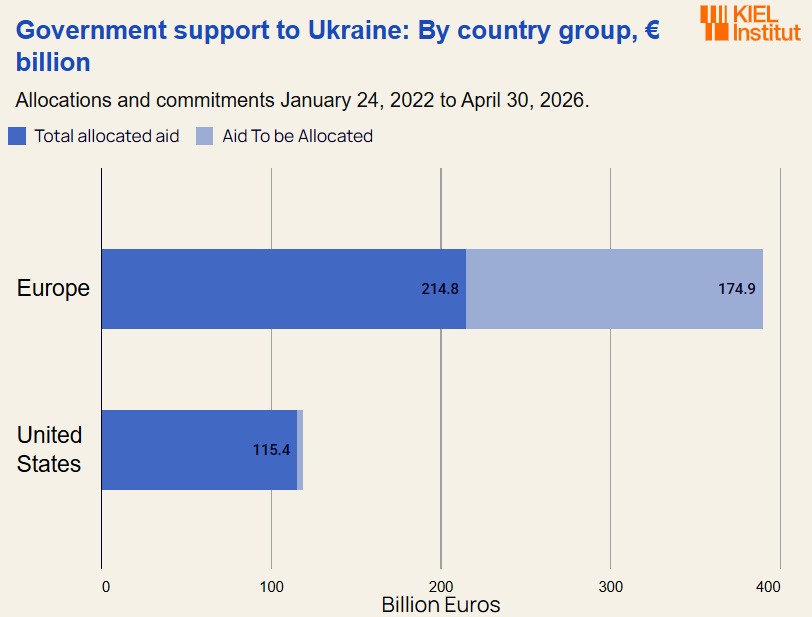
The United States has provided roughly $180 billion in total support to Ukraine since 2022. Europe has provided more, though its accounting is more diffuse. Together, the total Western commitment to Ukraine’s war effort sits in the range of $500 billion over four years.
For that money, the West has purchased the systematic degradation of russia’s military. Russia has lost, by conservative estimates, more than 400,000 casualties, thousands of tanks, hundreds of aircraft, most of its Black Sea Fleet, and a significant portion of its long-range precision-strike capability. Its most modern combat vehicles have been destroyed in numbers russia’s defense industry cannot replace at pace. Its officer corps has been hollowed out. Its air-defense network has been degraded to the point where Ukrainian drones now reach Omsk, three thousand kilometers from the front. Its shadow fleet has lost 172 vessels in the past two weeks alone.
None of this has been achieved with American soldiers. None of it required NATO to enter a direct war. All of it was accomplished by Ukrainians willing to do the fighting themselves, using a combination of Western equipment and their own industrial capacity – Ukraine now produces three million drones a year, ten times the American figure, and does so under continuous russian bombardment.
The cost per unit of strategic outcome achieved here is unlike anything the West has managed in modern military history. The Iraq War cost roughly $2 trillion and produced no comparable strategic outcome against any comparable adversary. The war on terror cost more than $8 trillion. The Cold War itself, adjusted for the value of what it produced, cost multiples of what Ukraine is asking for.
Ukraine is asking for a fraction of what previous strategic contests have cost, to accomplish something more valuable than most of them accomplished: the degradation of russia’s ability to threaten Europe militarily for a generation.
The West is treating this as expensive. It is not expensive. It is the cheapest strategic bargain any American or European taxpayer has been offered in decades.
What russia’s actual condition tells us
The economic accounting extends to russia’s side too, and here the misdiagnosis is even sharper.
Vladimir Milov, russia’s former Deputy Minister of Energy and now one of the most credible russian opposition voices in exile, gave a recent interview in which he described in specific detail what the West’s analytical class has failed to see: russia’s economy is not resilient. It is in structural decline that has been accelerating throughout 2026. Oil and gas revenues collapsed 33 percent in the first eight days of July. The Central Bank’s reserve fund is exhausted, according to Governor Nabiullina’s own public admission. The ministry of finance is burning through Chinese yuan and gold reserves at approximately $600 million a month to cover the deficit. Consumer credit has collapsed by half. Industrial production is contracting. Sixty-two of Russia’s 89 regions are now subsidy-dependent.
Ukrainian drone strikes have hit every major russian refinery west of Omsk, and Omsk too. Every ammunition depot, marshalling yard, and Baltic port terminal in European russia is now under continuous attack. The war economy that funded russia’s aggression is being dismantled by the country russia planned to capture in three days.
Milov’s own assessment is that the war may be very close to its end, and that Western analysts have systematically misread russian resilience because they have been reading the wrong indicators. The West has been watching russia’s headline GDP figures and assuming continued strength. The correct indicator is the composition of russia’s spending – almost entirely military-industrial, funded by rapidly depleting reserves, propped up by increasingly desperate workarounds like reintroducing Euro-3 gasoline and importing refined fuel from India at a loss.
This is not a country that can outlast Ukraine in a war of attrition. It is a country in the final stages of the very condition that Western sanctions were designed to produce, at exactly the moment when Western support could deliver the strategic result.
What abandoning Ukraine actually costs
In 1994, Ukraine surrendered the world’s third-largest nuclear arsenal – roughly 1,900 strategic warheads – in exchange for security assurances from the United States, the United Kingdom, and russia under the Budapest Memorandum. Russia violated those assurances in 2014 and again catastrophically in 2022. If the West responds by abandoning Ukraine now, the message to every non-nuclear state on earth will be unambiguous: nuclear weapons are the only real security guarantee, and international commitments from nuclear powers cannot be trusted.
The strategic consequences of that message are enormous and quantifiable. Japan and South Korea would almost certainly reconsider their non-nuclear postures. Saudi Arabia, Turkey, Egypt, and Poland would face immediate domestic pressure to acquire nuclear weapons. Iran’s program would accelerate under the framing that its neighbors are moving in the same direction. The nonproliferation regime that has held for eighty years – imperfectly, but consequentially – would collapse within a decade.
The cost of that collapse, measured in future crises, future arms races, and future wars, dwarfs any conceivable cost of continuing to support Ukraine now.
The same logic applies to the international system more broadly. If borders can be changed by force in Europe in 2026, they can be changed by force in the Taiwan Strait in 2027, in the South China Sea in 2028, in the Caucasus, in Central Asia, in the Arctic. Every American administration for eighty years has understood that the rules-based international order is not a moral construct but a strategic asset – one that produces enormous economic and security benefits for the United States specifically. Abandoning Ukraine liquidates that asset. What replaces it will not be a return to a simpler world. It will be a world in which every strategic contest is more expensive, more violent, and less predictable than the one the West is currently choosing not to finish.
The moral question
There is a persistent framing in American commentary that treats support for Ukraine as either a moral position or a strategic one, as if the two could be separated.
Ukraine is a country that chose democracy under conditions of extreme russian pressure, was invaded for that choice, and has spent four years defending it at a cost of hundreds of thousands of casualties. Its citizens are not asking Western soldiers to fight for them. They are fighting themselves. What they are asking for is the material support to keep doing so.
Denying that support is not neutrality. It is the specific active choice to let the outcome be determined by russian force. As Dietrich Bonhoeffer put it, in a context Americans of a certain political tradition claim to admire: silence in the face of evil is itself evil. That principle is not decoration. It is the recognition that in strategic contests where power is being used to determine outcomes, disengagement is not an absence of choice. It is a choice.
The West spent the entire Cold War operating on that recognition. Every American president from Truman to Reagan understood that the strategic cost of abandoning allies to Soviet aggression was higher than the cost of standing with them. The current wavering on Ukraine is a break from that entire tradition, and the break is being made on the basis of an accounting error.
What Ukraine is buying with its own blood
Ukraine has already accomplished, at devastating cost, what the West’s strategic planning documents identified as central American security goals a decade ago. It has significantly weakened the Russian military. It has demonstrated that democracies are capable of defending themselves against authoritarian aggression. It has shown that mid-sized military powers can achieve outcomes against larger adversaries when they combine will, industrial capacity, and Western support.
None of this required American soldiers. None of it involved NATO in direct combat. All of it has been achieved by Ukrainians using a combination of Western equipment and their own extraordinary military and industrial improvisation.
The West is being offered the achievement of its own strategic goals at a fraction of the price it has historically paid for far less consequential results. The choice to walk away is not a choice to save money. It is a choice to pay much more, later, for a much worse outcome.
What is actually at stake
Ukraine is not asking the West to fight its war. Ukrainians are already doing that.
The question the West faces is whether it will provide the material support necessary for Ukraine to finish what it has already largely accomplished – or whether it will hesitate long enough, at exactly the moment russia is weakest, to allow russia to reconstitute and return with a stronger military, a nuclear-proliferated neighborhood, and a rules-based order it has learned it can break with impunity.
The economics of that choice are not close.
Ukraine is the cheapest strategic bargain of the century. Every month the West continues to describe it as expensive is a month lost to a specific analytical error that history will be unforgiving about.
Ukraine is not optional. It never was.
Slava Ukraini.
This is the most cogent analysis that I have read In all the years since Russia began its war against Ukraine. Every Republican in Congress who is literate should read it. Thank you! Slava Ukraini!