
Spider’s Web, One Year Later
Everything the operation predicted has come true. The reality has gone further.

Last year, I wrote about the incredible and historic success of the Operation Spider’s Web. I argued then that it was a strategic inflection point in the war – that it would be studied at military academies for decades, that it would force russia to mistrust its own logistics, and that it had rewritten the rules of asymmetric warfare in the twenty-first century.
A year later, every part of that argument has held. The harder question now is whether anyone could have predicted how far this would go.
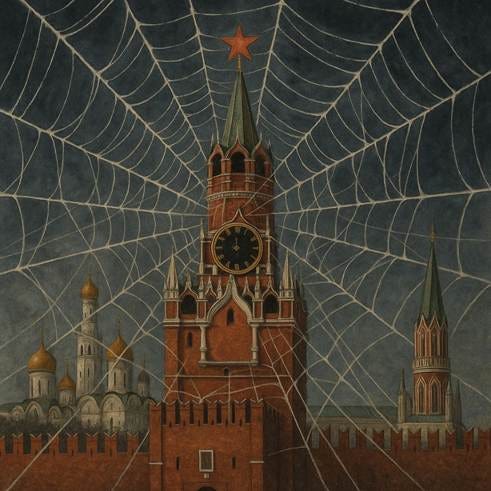
Consider what was true in russia by late March 2026.
Oil exports fell forty-three percent in a single week – from four million barrels per day to 2.3 million. The lost revenue, in seven days, was about a billion dollars. By the end of that month, nearly forty percent of russia’s total oil export capacity was offline because Ukrainian drones had hit it. The Center for Macroeconomic Analysis and Short-Term Forecasting in Moscow nearly halved its 2026 growth forecast for the russian economy and named the drone campaign as the cause. Harvard researchers began calculating the oil price required to keep russia’s 2026 budget solvent.
A year ago this week, the campaign that produced these numbers began with a swarm of cheap quadcopters bursting out of the roofs of unsuspecting cargo trucks deep inside russia.
What Spider’s Web actually did
For readers encountering this story for the first time, a brief recap.
On June 1, 2025 – russia’s Military Transport Aviation Day, which made it doubly humiliating – the Security Service of Ukraine launched 117 first-person view drones from inside russia itself. The drones had been smuggled across thousands of kilometers in cargo trucks with custom-built wooden compartments hidden under the roofs. The russian drivers had no idea what they were carrying. At the moment of attack, the roofs opened by remote command, and the drones flew out toward four strategic russian airbases stretching across five time zones – from Murmansk in the Arctic to Belaya in eastern Siberia, more than four thousand kilometers from the Ukrainian border.
The strikes hit Tu-95 and Tu-22M3 strategic bombers and A-50 surveillance planes – the aircraft russia used to launch the cruise missiles that have killed Ukrainian civilians for years. Ukrainian intelligence reported forty-one aircraft destroyed or damaged. Open-source analysts confirmed at least thirteen. U.S. officials estimated twenty hit and around ten destroyed. The Lawfare Institute’s minimum confirmed assessment was eight Tu-95s, four Tu-22M3s, and one An-22 transport aircraft.
Whichever number you accept, the operation took a serious bite out of russia’s strategic aviation fleet – aircraft that are no longer in production and cannot be replaced. The financial damage was estimated at seven billion dollars. The russian military bloggers called it russia’s Pearl Harbor. That comparison has aged into a fair description.
The planning took eighteen months and nine days. The cost to Ukraine was a few thousand dollars per drone.
The year since
I argued at the time that Spider’s Web mattered for three reasons beyond the immediate damage: it weaponized russian paranoia, it demonstrated that smaller nations can confront larger ones through innovation rather than parity, and it signaled to Ukraine’s allies that strategic clarity and the freedom to act could substitute for sheer mass.
A year of evidence has confirmed all three.
The paranoia has become structural. Every cargo truck in russia is now a potential threat. Internal security resources have been diverted to monitor logistics across eleven time zones. Aircraft that survived Spider’s Web have been dispersed to bases further east, raising operating costs and reducing readiness. Some have been rerouted across the country in expensive convoy operations. Russia has spent the year hardening its rear areas against an enemy that, by russian doctrine, should never have been able to reach them.
The innovation has scaled. In June 2025, the Spider’s Web concept of smuggled drones launching from inside russia was a single audacious operation. By 2026, deep strikes against russian territory have become a sustained strategic campaign. In March 2026, for the first time since the full-scale invasion began, Ukraine launched more drones than russia did – 7,347 to russia’s 6,462. The country that was supposed to be on the defensive is now setting the pace of the air war.
The signal to allies has translated into Ukrainian leadership of a new kind of war. The Unmanned Systems Forces – the world’s first dedicated drone branch of a national military – was established just two days after Spider’s Web. Robert “Madyar” Brovdi was named its commander in June 2025. Under his direction, Ukrainian drones have struck the Black Sea oil terminal at Tuapse four times in two weeks, the Baltic ports of Primorsk and Ust-Luga, the Lukoil refinery in Perm three times in a single fortnight, and oil infrastructure in Yaroslavl, Kstovo, Novorossiysk, Volgograd, and the Urals. Sixteen to seventeen major russian refineries have been hit. According to the SBU, nearly forty percent of russian refining capacity now sits idle for some part of the year.
What the year has clarified
There is a tendency, watching this campaign mature, to treat Spider’s Web as the spark and the year that followed as the fire. That framing is too simple. Spider’s Web was not the beginning of Ukrainian deep-strike capability. It was the moment that capability stopped being theoretical and became doctrine.
Before June 1, 2025, the question among Western analysts was whether Ukraine could reach russia’s strategic depth at all. After June 1, the question became how often. Within months, the question became how to interpret the economic consequences. A year later, russian government economists are halving their growth forecasts and naming Ukrainian drones as the cause.
This is what the year has clarified: Spider’s Web was not a one-off triumph. It was a proof of concept that has now been industrialized.
It has also clarified something about the broader war. For three years, russia bet that mass would defeat resolve – that an army of seven hundred thousand, drawn from a country more than three times Ukraine’s size, could grind down a smaller neighbor if the West eventually tired of supplying it. That bet has not paid off. That bet has not paid off. Russia is losing more soldiers each month than it can recruit. Its economy is being squeezed by the war it started. Its strategic aviation is depleted, its oil exports are wounded, and its rear areas are no longer safe.
Ukraine has not won the war. But the country that was supposed to fall in three days has, in three years, kept fighting – and taught the world that distance and size no longer guarantee safety.
I wrote a year ago that Spider’s Web was a warning to all who believed otherwise. I stand by that warning today. The only thing that has changed is the volume of evidence behind it.
This is still how you stop a war. Not just by defending your territory, but by reaching deep into the heart of the aggressor’s system and shaking its confidence until the cost of continuing exceeds what the aggressor is willing to pay.
A year ago, that was a thesis.
Today, it is a measurable fact.
Slava Ukraini.