
Russia’s Oil Curse
How the commodity that funded russia’s war has become the pressure point that could end it

For the past thirty years, Russia’s oil sector has been the country’s economic superpower and its strategic insurance policy. High crude prices funded Vladimir Putin’s rearmament, subsidized the loyalty of his regional governors, and gave the Kremlin the confidence that no Western sanctions regime could ever really hurt it. Oil bought Russia its aggression. Oil bought Russia its impunity.
In 2026, that same oil sector has become Russia’s biggest liability. And the country that turned oil from asset into liability is not the United States, not the European Union, not OPEC. It is Ukraine.
What Ukraine has done
Since the beginning of this year, Ukrainian long-range drone forces have struck Russian oil infrastructure at a scale that has quietly rewritten the economics of the war. The list of strikes reads like an atlas of Russian energy production.
Four days ago, on July 6, Ukraine struck the Omsk refinery in western Siberia. Omsk is Russia’s largest oil refinery by processing capacity – 22 to 23 million tons of crude per year, roughly 10 percent of Russia’s total refining capacity. The refinery halted operations the following day. The strike traveled approximately 3,000 kilometers from Ukrainian territory, making it the deepest long-range attack of the war. Ukraine’s Special Operations Forces used upgraded Fire Point FP-1 drones. President Zelenskyy called it “an important achievement for the Armed Forces of Ukraine. Siberia, too, is now within reach of Ukrainian precision strikes.”
The Omsk strike matters beyond its own scale. The facility was the last of Russia’s eleven largest gasoline producers to be hit. Every major refinery in Russia has now been struck. And Omsk is Russia’s only producer of catalytic cracking catalysts – the industrial materials that other Russian refineries use in their secondary refining operations. Damaging Omsk does not just take Omsk offline. It weakens the maintenance and operational capacity of every other refinery in the country.
Lukoil-Nizhegorodnefteorgsintez, Russia's fourth-largest refinery and the second-largest producer of gasoline for the Moscow region, was hit last week. Its primary distillation unit is offline. Without it, the downstream units that produce marketable fuel have no feedstock. The facility processes 17 million tons of crude oil a year, or did.
The Ilsky refinery in Krasnodar was hit again earlier this month – its fourth strike since January. The Yaroslavl Oil Refinery, one of Russia’s five largest, was struck on the same day as Omsk. The port of Taganrog on the Sea of Azov, the Azov Optical-Mechanical Plant, and an oil depot in Azov were hit in a coordinated wave. Ukraine also struck the Ust-Luga and Vysotsk oil terminals on the Baltic Sea in the same period. Fourteen Russian tankers were destroyed overnight last week. Ukraine has now destroyed 49 Russian vessels, refineries, and depots in the past several days alone.
The most symbolic strike of the year before Omsk was on the St. Petersburg port – 1,100 kilometers from the Ukrainian border and home to one of the largest oil transshipment terminals on the Baltic Sea. Ukraine set the terminal on fire. St. Petersburg happens to be Vladimir Putin’s hometown.
A recent Financial Times analysis found that Ukrainian drones struck Russian oil refineries at least 194 times during the first half of 2026, reaching a record monthly pace in May.
When Donald Trump asked Volodymyr Zelenskyy last week whether he would visit Moscow, Zelenskyy answered: “It’s difficult. There are lots of Ukrainian drones there. It’s dangerous.”
The moral asymmetry
There is a moral asymmetry to what is happening on both sides of this war and it deserves to be named clearly.
Russia strikes Ukrainian residential buildings, maternity wards, schools, cathedrals, and children in metro stations. Ukraine strikes Russian oil refineries, oil ports, oil depots, and defense factories. Russia’s targeting is designed to kill civilians and destroy the possibility of ordinary Ukrainian life. Ukraine’s targeting is designed to cut off the revenue and materiel that fund Russian military operations. Both sides are using drones. What they do with them is not the same thing.
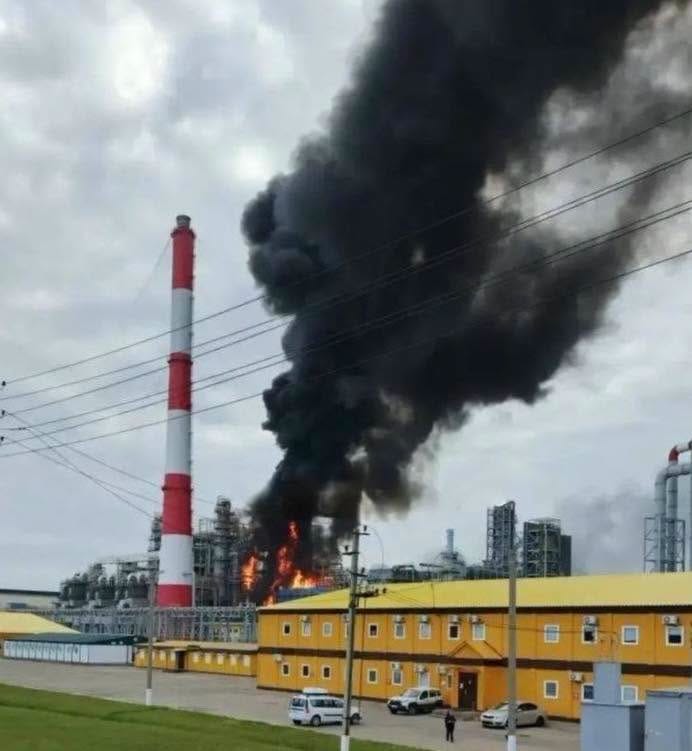
(The photo shows the aftermath of Ukrainian drone hitting one of russia’s largest petrochemical complexes in Nizhnekamsk, Tatarstan, located more than 1,200 km from the Ukrainian border.)
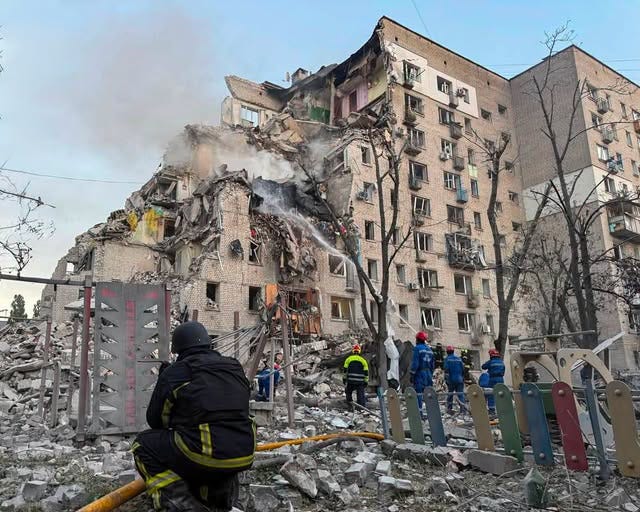
(The photo shows the aftermath of Russian drone hitting a residential building in Kyiv, killing eight civilians.)
The economic asymmetry
There is also an economic asymmetry, and this is the more important structural point.
A single Ukrainian drone – costing anywhere from a few thousand to perhaps a few tens of thousands of dollars, depending on range and payload – can destroy a Russian oil facility worth hundreds of millions of dollars. The math is devastating for Russia because oil infrastructure is uniquely vulnerable to drone strikes. Refineries and depots are enormous, immobile, difficult to defend across their full perimeter, and full of the world’s most flammable industrial material. A drone does not need a heavy warhead to ignite an oil facility. It needs to arrive.
Ukraine now has the industrial capacity to arrive at almost every important Russian oil facility west of Omsk, and it has demonstrated it can reach Omsk too. The strategic implication is that Russia’s oil sector is no longer defended by geography. The Ural Mountains do not stop drones. Distance no longer protects the refineries that turn Russian crude into Russian revenue.
What Russia is trying to do about it
The Kremlin’s response has followed the classic pattern of a state trying to solve a structural problem with tactical fixes.
First, Russia is lowering fuel quality. The government has authorized the sale of Euro-3 gasoline through the end of the year – a standard banned in Russia in 2016 for environmental reasons. Tax rules now allow lower-quality components to be blended into marketable fuel. This bypasses damaged refining units. It also degrades vehicle performance, damages modern engines, and increases air pollution in Russian cities. Russia is now shifting the cost of the fuel crisis from the state budget onto car owners and public health.
Second, Russia is importing gasoline. The Kremlin plans to import up to 400,000 tons of gasoline per month, primarily from Belarus, Kazakhstan, and India. The India arrangement is the most absurd: Russia exports crude to India, an Indian refinery processes it, and Russia buys back more expensive refined gasoline that includes the added costs of refining, shipping, insurance, and transshipment. Russia is effectively paying a tax to India to compensate for infrastructure Ukraine has destroyed.
Third, Russia is redistributing fuel between regions. The mandatory share of gasoline sold on Russia’s commodity exchange has been reduced from 15 percent to 10 percent, keeping more fuel inside the vertically integrated oil companies that supply Moscow and St. Petersburg. Rural Russia and the Russian Far East are being cut off. Gas stations are closing across Krasnodar, Irkutsk, Transbaikalia, and the Volga region. Manual fuel rationing has become the norm in the occupied territories.
Fourth, Russia is now installing portable toilets alongside the miles-long lines of Russian citizens waiting days for five gallons of gasoline. This is not economic policy. It is the state’s acknowledgment that its citizens will be standing in fuel lines for a very long time.
Why every fix creates a new problem
The deeper issue is that Russia’s war economy has no engine other than oil. Every workaround the Kremlin attempts creates its own economic drag.
Lower fuel quality accelerates vehicle wear, which raises repair costs, which strains household budgets, which suppresses consumer spending. Imports require the federal budget to subsidize the price gap between more expensive foreign fuel and administratively suppressed domestic prices – a subsidy that would cost the state $40 to $80 million per month at current volumes and rises as the gap widens. Regional redistribution shifts the political cost of the crisis from Moscow onto rural and peripheral regions – which is manageable politically for a while, but not indefinitely. The federal budget was already running a real deficit in early 2026, driven by falling oil and gas revenues. Every ruble the state spends subsidizing gasoline imports is a ruble not spent on soldiers, defense factories, or the pensions and social payments that keep the Russian population quiet.
The Kremlin is playing whack-a-mole with a problem that structurally cannot be solved as long as Ukrainian drones can reach Russian refineries. And Ukrainian drones can reach almost anywhere now.
What this means
For most of this war, Western analysts have argued that Russia’s economy is more resilient than sanctions can break and that Russia can outlast Ukraine in a war of attrition. Both claims rested on an unspoken assumption: that Russia’s oil sector would continue to generate the revenue that funds Russia’s aggression.
That assumption is no longer safe. Ukraine has demonstrated, over the past year, that Russian oil infrastructure is not a strategic asset. It is a strategic vulnerability. It is enormous, immobile, flammable, and now within range of Ukrainian drones from Rostov to St. Petersburg to Omsk. Every strike that takes a Russian refinery offline reduces Russian export revenue, damages Russian federal budget projections, disrupts Russian domestic fuel supply, and forces the Kremlin into workarounds that cost more than the strikes themselves.
The strategic implication for the West is important. The most cost-effective way to weaken Russia’s ability to prosecute this war is to help Ukraine do more of what it is already doing. Better Ukrainian drone technology. Longer Ukrainian drone range. More Ukrainian drone production capacity. Tighter Western sanctions on the traders and shippers and refineries – including Nayara Energy, half-owned by Rosneft – that are helping Russia work around the damage.
Russia spent thirty years building a war economy on oil. Ukraine is now dismantling it, one refinery at a time, with drones that cost less than the toilets Russia is placing next to its own fuel lines.
The commodity that funded Russia’s aggression has become the pressure point that could end it. And the country doing the pressing is the one Russia was supposed to have already destroyed.
Slava Ukraini.
There is another aspect to consider. Crude oil that cannot be processed, stored, or shipped is not extracted. What is to be done with it?
Oil wells cannot simply be turned on or off like a water tap.
High pressure:
Underground, crude oil is often under immense pressure. Closing a valve carries the risk that the pressure could damage the wellbore or cause the oil to leak uncontrollably elsewhere.
Fluids:
To stop the flow, wells must be laboriously flooded with heavy drilling mud and permanently sealed with multiple concrete plugs.