
Mark the Date
Why many intelligent people believe false things

Yesterday, John Mearsheimer said russia will hold all of Donbas by year’s end. Mark the date. Check it again in December.
He has been making versions of this prediction for four years. In February 2024, he told Global Times – a Chinese state outlet, which tells you something about the audience he prefers – that the actual fighting would not last beyond 2025. He was wrong. He said russia would have Kharkiv. Wrong. He said Kyiv would fall. Wrong. He said Ukraine would collapse politically. Wrong. He said the Ukrainian army would run out of soldiers, ammunition, will. Wrong. Wrong. Wrong.
And yet every time Mearsheimer makes a new prediction, Western audiences give him another platform. Every wrong prediction is followed by a new one, delivered with the same confidence, the same clipped academic authority, the same subtle implication that the people who disagree with him simply do not understand the “realist” framework of international politics.
Mearsheimer is not alone. Jeffrey Sachs has spent four years telling audiences that NATO expansion caused russia’s war against Ukraine, that Ukraine is a corrupt puppet state, that Western support for Kyiv is prolonging an unwinnable conflict. Noam Chomsky made similar claims for two decades. Together these three men have produced the best material for the russian propaganda – despite the fact that they have been wrong on essentially every point that they maid.
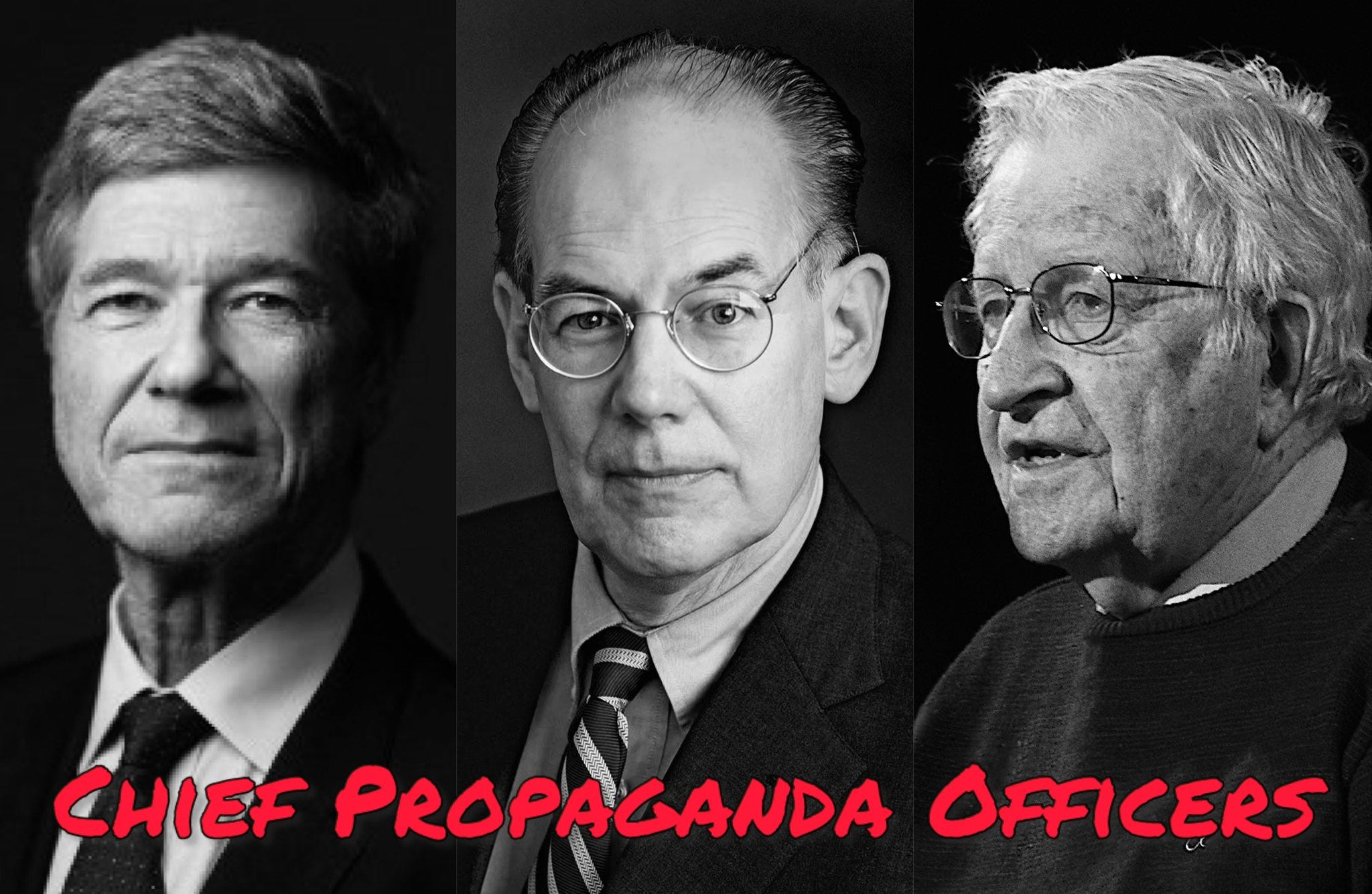
How does this happen? How do educated, credentialed, articulate people believe and repeat claims that do not survive contact with basic evidence? And why do their audiences continue to believe them, even after each prediction fails?
This is not a story about specific individuals. It is a story about the structure of the modern information environment – and about a specific kind of failure that structure now produces at industrial scale.
Information is abundant, attention is not.
For most of human history, information was expensive. Books were scarce. News traveled slowly. Knowledge was protected by institutions that had strong economic incentives to be right.
Today, information is free to produce and free to distribute. Every minute, hundreds of hours of video are uploaded online. Millions of social media posts are published every day. Thousands of articles compete for attention every hour.
The human brain has not evolved to process this volume. Our ancestors had to decide what to believe based on limited information. Today we face the opposite challenge: deciding what to ignore.
When overwhelmed, people stop evaluating evidence carefully and start relying on shortcuts. We trust headlines. We trust people who sound confident. We trust sources that confirm what we already believe. Each of those shortcuts can lead us further from the truth.
The incentives reward attention, not accuracy.
Most people assume information providers are motivated by a desire to inform. Sometimes they are. But the institutions, platforms, and individuals who dominate the information ecosystem face different incentives.
News organizations compete for clicks. Influencers compete for followers. Content creators compete for views. Social media accounts compete for engagement. For them, accuracy doesn’t matter as much as attention.
A boring truth receives little attention. An outrageous lie can travel the world in hours. Anger spreads faster than analysis. Fear spreads faster than nuance. The result is a structural advantage for the most emotionally charged content, regardless of whether it is true.
We should not be surprised that public discourse has become increasingly emotional and increasingly polarized. The incentives encourage exactly that.
The institutions that once filtered information have collapsed.
For two centuries, the Western information ecosystem rested on a small set of professional gatekeepers. Newspapers had editors. Universities had peer review. Scientific journals had referees. Television networks had standards-and-practices departments. These institutions made plenty of mistakes, but they shared one feature: a person who published a false story or an inaccurate study faced consequences. Reputations could be destroyed. Careers could end. Accountability was structural.
Most of that has collapsed.
Traditional media has been hollowed out by the economics of digital advertising. Newspapers that once employed hundreds of reporters now employ a handful. Universities and academic institutions face declining public trust, and many have weakened their own credibility through politicization and through scandals around replication, retractions, and ideological enforcement. The expert class has lost the moral authority it once held.
And into that vacuum, a new information environment has emerged – one built not on gatekeepers but on algorithms. The algorithm does not care whether a claim is true. It cares whether the claim generates engagement. This has produced a structural advantage for the most confident, the most emotional, and the most viral. It has not produced a structural advantage for the correct.
We are not in 1984. We are in Brave New World.
For most of the twentieth century, the Western mental model of authoritarian information control was drawn from George Orwell’s 1984. A central regime suppresses truth by force. Books are burned. Journalists are jailed. Dissenting voices are silenced. That is still the model in the residual authoritarian world – in China, in russia, in North Korea, in Iran.
But the sophisticated information control of the twenty-first century, in countries where truth cannot be suppressed by force, is Huxleyan rather than Orwellian. It does not remove truth. It drowns truth.
Modern propaganda does not need to censor. It needs only to flood. Propaganda, outrage, half-truths, conspiracy theories, influencer theater, algorithmic rage bait, an endless stream of content engineered not to inform but to keep audiences emotionally stimulated. A fact no longer has to be disproven. It only has to be surrounded by a hundred competing claims, stripped of context, turned into partisan ammunition, and pushed into the same feed as celebrity gossip and fifteen-second videos engineered for the fastest possible dopamine hit. By the time truth reaches the reader, it looks like just another piece of content competing for attention.
This is a more sophisticated form of control than Orwell imagined. Orwell feared a world in which people would be deprived of information. Huxley feared a world in which they would be given so much distraction, stimulation, and triviality that they would lose the desire to seek anything else.
Huxley was closer.
The regime does not have to lie to us. The environment does the work.
What this looks like in practice
Russia has understood the current information environment for a decade longer than the West has. It has invested billions of dollars in shaping it. It has built industrial-scale operations to flood Western feeds with content designed to exhaust the truth into invisibility. Vladimir Putin does not need to convince the West that Ukraine caused the war. He needs to place one hundred competing claims into the feed alongside every accurate account, until the average Western citizen concludes that “we don’t really know what happened” and disengages.
That is the entire strategy. And it works.
Which brings us back to Mearsheimer, Sachs, and Chomsky.
I do not believe these three men are on a russian payroll. I do not believe they consciously repeat Kremlin talking points. What I believe is that they have arrived at conclusions that russian propaganda finds enormously useful, and they have arrived at them through the same structural failures the information environment now produces at scale.
Consider what their framework requires you to believe. That NATO expansion – a purely defensive alliance that no country has ever been forced to join – caused russia to invade Ukraine. That Ukraine, a country that has resisted three centuries of russian imperial pressure, is somehow a Western puppet with no independent will. That russia’s behavior toward Ukraine is a response to Western provocation, rather than the continuation of a five-hundred-year pattern of russian imperial expansion that predates NATO, predates the United States, and predates many currently existing European nation-states.
None of these claims survives serious contact with evidence. But most of them dominate Western feeds.
How does this happen? Three specific failures.
Expertise does not generalize. Being highly competent in one field does not make someone an expert in another. Mearsheimer is a political theorist, not a historian of Eastern Europe. Sachs is an economist, not a specialist in russian imperial behavior. Chomsky was a linguist. None of them has demonstrated deep knowledge of Ukrainian history, russian history, or the specific mechanisms by which russia’s imperial project has been executed against every one of its neighbors for centuries. Their claims about the region rest on frameworks – “realist” international relations theory, “anti-imperial” American foreign policy critique, “structural” analysis of great-power behavior – that were developed to explain other situations and that fail to capture what russia is and has always been.
Arguments should be judged on merit. The credibility of a claim does not depend on who makes it. It depends on whether it is correct. Mearsheimer, Sachs, and Chomsky are educated men who speak with confidence. That is not evidence that they are right. It is evidence that they are educated men who speak with confidence. The specific claims they make about russia’s war can be checked against specific evidence, and when they are checked, they fail.
Was there a binding agreement preventing NATO expansion? No. Was Ukraine forced into supporting NATO by American pressure? No. Ukrainian support for NATO was low before 2014 and rose sharply after russia invaded. Are Finland and Sweden also American puppets? Or did they, like Ukraine, decide independently that russia’s behavior made NATO membership desirable?
Historical patterns matter. Any framework that ignores russia’s five-hundred-year record of invading its neighbors cannot explain what is happening now. Russia invaded Finland in 1939. Poland in 1939. Hungary in 1956. Czechoslovakia in 1968. Georgia in 2008. Chechnya in the 1990s. This pattern predates NATO expansion. It predates the United States. It predates the entire framework that Mearsheimer, Sachs, and Chomsky use to explain russia’s war. Their model has no variable that can account for the pattern. So they ignore the pattern.
And when the pattern reasserts itself – as it always does – they explain each individual instance as a special case, produced by specific Western provocations, unrelated to the previous instance. It is not “russia keeps invading its neighbors because russia is an imperial society.” It is “NATO caused this one,” or “the CIA caused that one,” or “American hegemony caused the other one.” The framework absorbs every new russian invasion as a special case. It never asks whether the framework itself is wrong.
The strategic point
The result is a Western public discourse in which the loudest voices on russia’s war produce systematically false predictions, defended by systematically wrong frameworks, delivered with systematically high confidence. And the incentives of the modern information environment reward all three of those features. Confident is better than tentative. Simple is better than complex. Emotionally satisfying is better than empirically true.
The people who could correct this – Ukrainian government insiders, Ukrainian journalists, Ukrainian historians, Ukrainian soldiers on the front line – cannot compete for Western attention with a Chicago professor who says provocative things in clipped sentences on YouTube. Mearsheimer gets millions of views. The people who actually know what is happening get thousands. The gap is not accidental. It is what the algorithm produces.
What to do about it
Truth has become expensive. It requires paying a cost most people are not willing to pay.
It requires reading things that are hard. It requires listening to experts we do not enjoy. It requires accepting that most of what the algorithm delivers is not information but stimulation. It requires sitting with uncertainty when the feed offers us satisfying certainty for free.
And it requires holding specific commentators accountable when their specific predictions turn out to be wrong.
That is why I am marking the date. Mearsheimer said, in July 2026, that russia will hold all of Donbas by year’s end. Write it down. Check it in December. If he is wrong again – as he has been every year for four years – note that he is wrong, and note that being wrong for four consecutive years should carry a cost even in an information environment that no longer imposes one.
If we cannot rebuild the institutions that used to hold the confidently wrong accountable, we can at least, as individuals, refuse to reward them.
Mearsheimer says russia will control all of Donbas by year’s end.
Mark the date.
Slava Ukraini.
This is brilliant.
A correct analysis of forecasts for Ukraine in the long and short run, according to highly educated experts. If you are not on Ukraine's side in advance, you are on russia's side. There is no third party during such a war. The higher the expert's scientific level, the greater the responsibility he bears for an opinion that is not supported by his own research and knowledge.