
Hitler's Cross
What happens when the church trades the Gospel for political power.

I recently came across a book called Hitler’s Cross, by Erwin Lutzer. It examines how the Nazi regime manipulated Christianity to advance its political and ideological goals, and how most of the German church – the institutional body charged with preserving the teaching of Christ – allowed itself to be captured.
It is a sobering study of what happens when a religious institution chooses stability over truth.
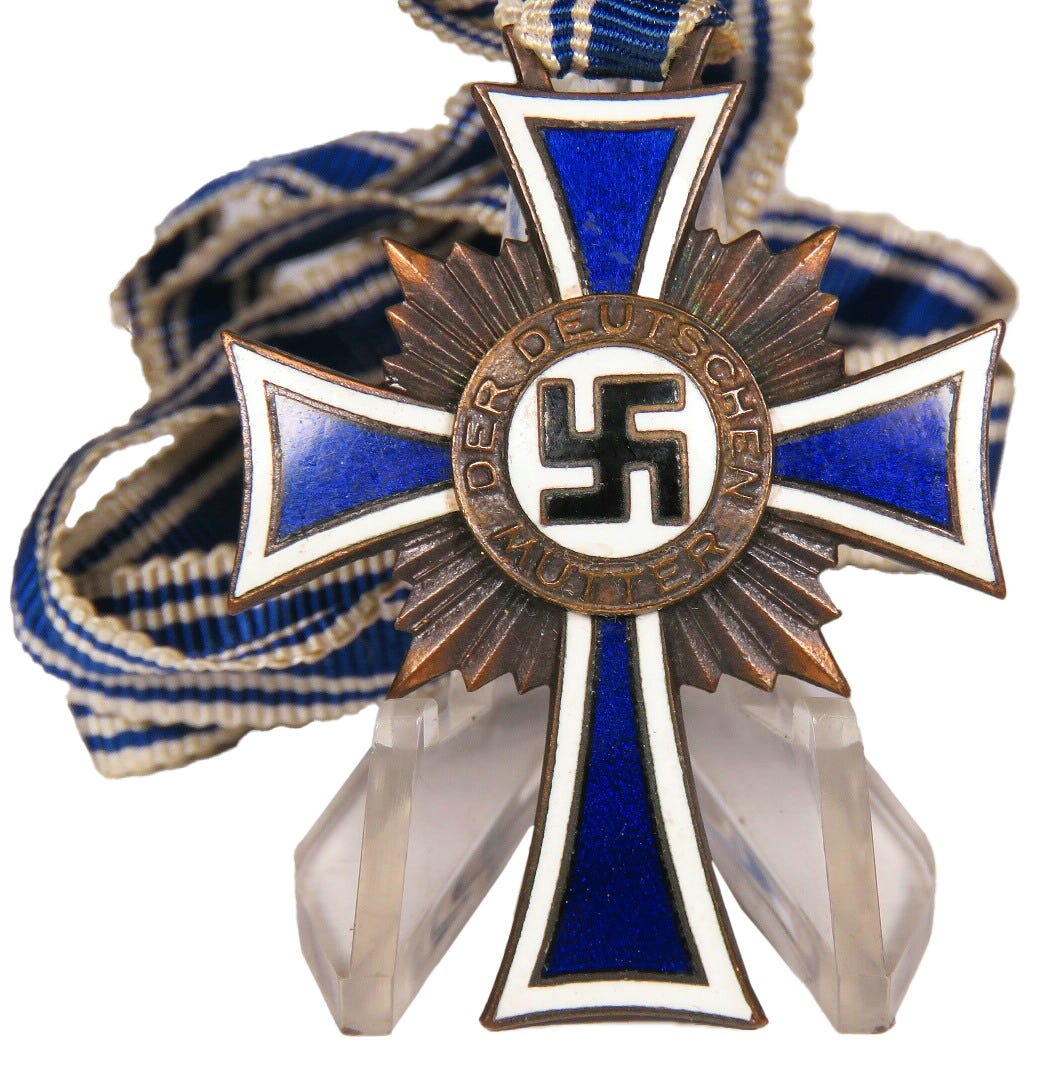
The hijacking
The regime did not destroy Christianity. It re-engineered it.
Nazi propaganda blended nationalism with religious language until the two became indistinguishable. The state presented itself as the instrument of God’s will. Crosses appeared beside swastikas in churches across the country. Pastors preached that loyalty to the regime was loyalty to a higher purpose. Theology was bent until it justified policies that stood in direct contradiction to the teachings of Christ.
This new construction had a name: German Christianity. It looked like the Gospel. It used the same words. It worshipped in the same buildings. But it had become something else – a religion of the state, dressed in the symbols of a faith it had stopped believing in.
The failure of the church
The most disturbing fact in the historical record is not that the regime tried to capture the church. Regimes always try. The disturbing fact is how easy it was.
Most churches did not resist. Some openly supported the regime. Many remained silent. Pastors pledged loyalty to the state. Theological faculties revised their doctrine to align with the new ideology. Institutions that had been built across centuries of Christian witness chose, almost overnight, to preserve themselves rather than their message.
A small minority stood firm. The Confessing Church – led by figures including Dietrich Bonhoeffer and Martin Niemöller – refused to surrender Christian teaching to political power. They paid for it. Bonhoeffer was executed in a concentration camp in April 1945, weeks before the war ended. Niemöller spent eight years in Dachau and Sachsenhausen.
They were the exception. The exception is what we remember. The rule is what actually happened.
Why the institution failed
The reasons churches capitulated were not mysterious, and they are not unique to Germany.
The first was nationalism. The regime offered a story of national renewal, restored pride, and recovered greatness. For a church that had quietly identified with national identity for generations, this story was almost impossible to resist.
The second was fear. The cost of dissent was real, and visible. Pastors who spoke against the regime lost their pulpits, then their freedom, then sometimes their lives. Most chose silence, and most could justify the silence to themselves.
The third was compromise. Many believed they could preserve the essentials of faith by accommodating the regime on what seemed like secondary matters. They would keep the cross if they could just give the state the flag. They would keep the sacraments if they could just remove the troublesome passages from the lectionary. They would keep the institution by giving up its prophetic voice.
Faith that adapts itself to political power does not remain faith. It becomes something else. The institution survives. The witness does not.
Two crosses
Bonhoeffer wrote, in The Cost of Discipleship, about the difference between cheap grace and costly grace. Cheap grace is grace without repentance, forgiveness without confession, communion without obedience. It is what you get when the institution is preserved but the meaning is gone.
The cross of Christ represented humility, sacrifice, truth, and redemption. The cross the regime promoted represented power, domination, and the superiority of the nation. They were not the same cross. They were not even pointing in the same direction. Confusing them had catastrophic consequences for the German church, the German people, and the world.
What this teaches us
The lesson of Hitler’s cross is not really about Hitler. It is about the institutional vulnerability of any religious community when political power offers it a comfortable place at the table.
The incentives that captured the German church were ordinary incentives. The desire for relevance. The fear of marginalization. The love of country, sincerely held. The hope that quiet accommodation might preserve what loud resistance would lose. Each of these was understandable. None of them was sufficient.
History does not repeat itself in identical ways. But it often rhymes.
Niemöller, after the war, wrote what may be the most-quoted lines of the twentieth century: “First they came for the communists, and I did not speak out – because I was not a communist. Then they came for the socialists, and I did not speak out – because I was not a socialist. Then they came for the trade unionists, and I did not speak out – because I was not a trade unionist. Then they came for the Jews, and I did not speak out – because I was not a Jew. Then they came for me – and there was no one left to speak for me.”
He was a pastor when he wrote that. He had been silent at the moments when his witness might have mattered most. He spent the rest of his life trying to explain why.
The lessons of history are only useful if we are willing to recognize them. Not in abstraction. In the present.
Another reason, generally under-emphasized, is that many devout Christians are simply fascists, and their fascist worldview takes precedence over their Christian identity, or claimed devotion to Christian morality.
There don't have to be 'other reasons'.
When it comes to who chooses to align with fascism, there rarely (if ever) are any other reasons, only convenient cover stories and rationalizations.